



















A Smarter Approach to Capital Planning: Harnessing Data and AI to Uncover Alternatives that Minimize Risk and Maximize Impact
Minimize risk and maximize impact in utilities capital planning with a data-driven approach and AI capabilities to help generate key alternatives to inform investment decisions.
Power outages across the U.S. are becoming more frequent and lasting longer, according to recent data. While most of this can be attributed to more severe weather events, it’s exacerbated by changing customer behavior. Of course, it’s hard to ignore the problem at the core: aging infrastructure.
The average capacity-weighted age of the power generation fleet in the United States is about 28 years, with hydropower and nuclear reactors often being the oldest power generating facilities in the country.
These aren’t unknown issues to leaders in the utilities industry. But, for those responsible for building, managing, and executing capital plans, these challenges add immense complexity to the already difficult task of deploying finite capital with zero margin for error.
The Reality of Today’s Interconnected Complexities for Utilities Capital Planning
The traditional approach to utilities capital planning creates immense risk for organizations today. Using spreadsheets and relying on siloed department data creates gaps in information. Traditionally, organizations would have a rigid review cycle – making decisions on an annual basis and not updating the plans in between.
However, constraints continue to shift and impact critical milestones for projects in progress, as well as those slated for priority consideration. What happens when a regulatory body mandates a sudden budget cut? Or, if a supply chain bottleneck delays the delivery of critical components by 18 months, or longer?
Utilities leaders need visibility into how these constraints will impact grid reliability, ESG targets, and milestones in their capital plans.
These interconnected complexities create a web of constraints that require real-time data. Under the traditional model for capital planning, answering those shifting questions takes weeks of manual recalculation just to build a single new scenario. To survive, organizations don’t just need better data. They need the agility to instantly generate new, defendable investment pathways the moment the ground shifts.
Turning Capital Planning Into a Strategic Leading Indicator
To meet the dynamic needs of the modern grid, utility leaders must move away from the tools they’ve traditionally relied on. Static lists, disconnected spreadsheets, and rigid planning cycles provide a base level of information and insight into the state of infrastructure, but it’s not enough to power future decisions. Instead, they must rely on an agile, data-driven ecosystem for capital planning.
By leveraging modern technology, utility capital planning leaders can instantly visualize multiple, highly defensible investment pathways the moment constraints shift. Whether facing a sudden decrease in funding, a change in risk tolerance, or a shift in labor availability, leaders can use existing data to optimally balance competing priorities in real time.
With all data centralized in a single solution, it becomes a roadmap for the future. Meaning, it helps to guide critical decisions through the inevitable shifts and dynamic complexity that utility organizations face today.
A technology-forward, data-driven approach ensures teams fully understand which alternative investment scenarios are viable, allowing them to clearly see the trade-offs before settling on a single, potentially flawed solution.
Supporting Faster, More Comprehensive Capital Investment Analysis
Defining a strong set of investment alternatives takes time. Doing it well demands deep domain knowledge about how to solve the kinds of problems your organization faces. For experienced analysts, that knowledge is hard-won. For newer team members, or anyone working in an unfamiliar area, producing a truly comprehensive set of alternatives can mean hours of research, or gaps that only surface later in the review process.
The result is a process that’s inconsistent across teams, time-consuming to do well, and difficult to scale.
Endevor’s Portfolio module now features the Alternatives Generator, which helps capital planning teams build out a comprehensive set of investment alternatives – in seconds.
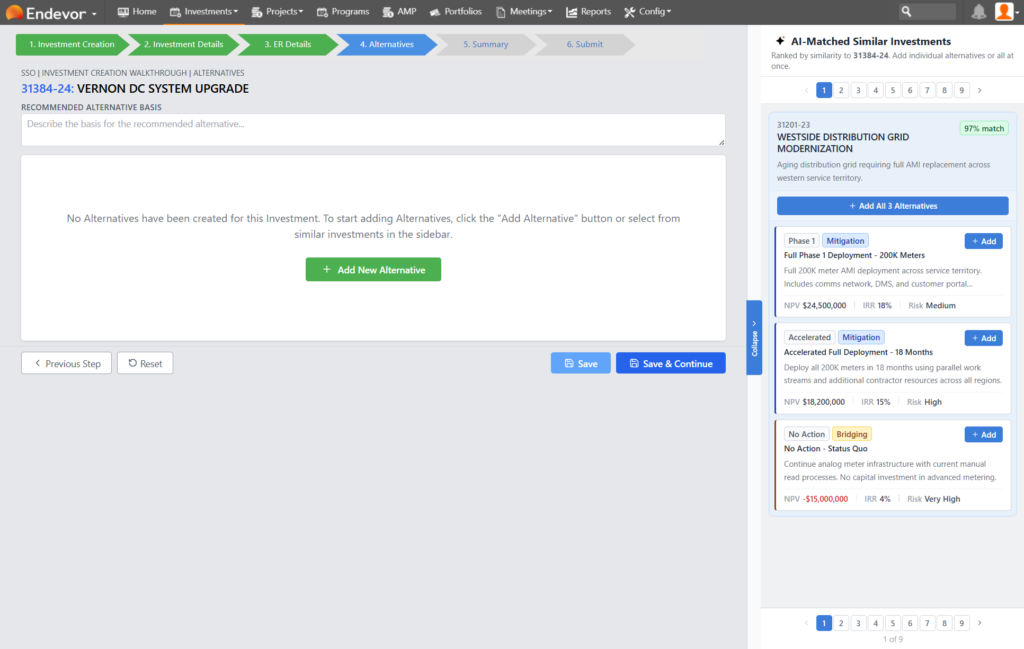
The Alternatives Generator leverages a similarity search model. It analyzes the investment’s problem description and identifies historical investments that are most closely related. It uses real investments from the organization’s history that faced comparable challenges.
The Portfolio module then surfaces those investments alongside the alternatives that were used to address them. With a single click, users can auto-populate the alternatives list with the ones most relevant to the situation.
Optimizing Capital Planning with Defined Alternatives
In Portfolio, alternatives aren’t just any solution. They represent specific strategies for dealing with a risk or gap:
- Bridging alternatives provide temporary solutions that sustain a system while a longer-term mitigation or elimination strategy is put in place.
- Mitigation alternatives reduce the severity or likelihood of a risk without fully eliminating it, useful when full resolution isn’t feasible or cost-effective.
- Elimination alternatives address the root cause directly, removing the risk entirely.
The Alternatives Generator helps teams see all three types of approaches surfaced from similar investments, making it easier to think through trade-offs rather than defaulting to a single solution type.
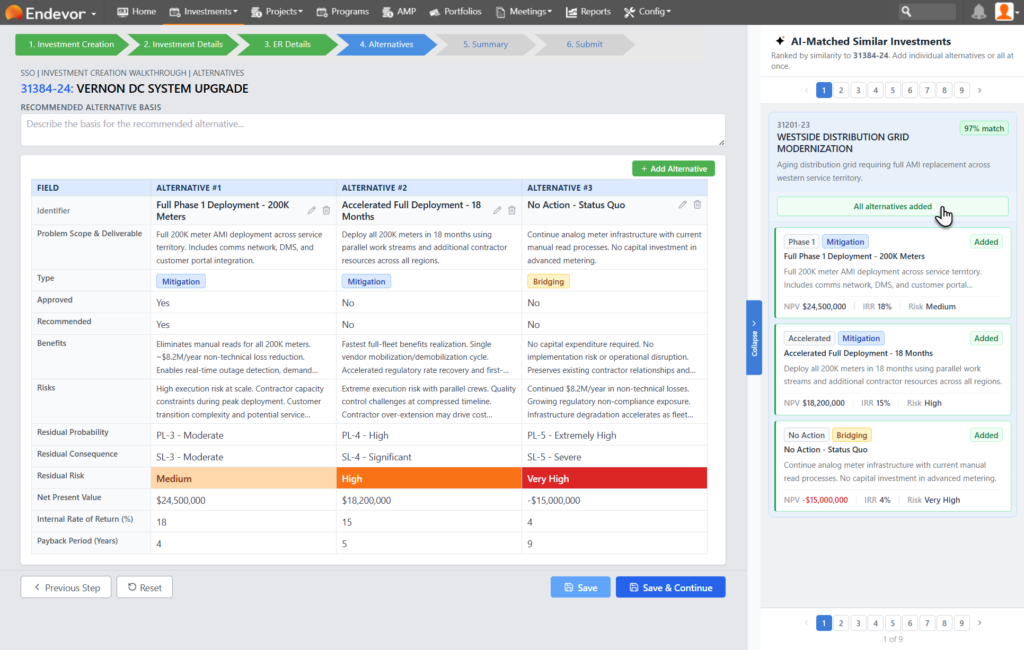
For investment analysts and portfolio managers, the benefits are immediate:
- Speed without sacrifice. Building a solid alternatives list no longer means starting from a blank page. The Alternatives Generator gives utilities capital planning teams a meaningful head start, grounded in real historical data.
- Consistency across teams. Whether an analyst has been with the organization for three months or thirty years, they have access to the same institutional knowledge. That levels the playing field and reduces variability in investment quality.
- Better decisions. When teams can see a broader range of alternatives – including approaches they may not have considered – they’re better positioned to select the option that best fits the investment’s risk profile, constraints, and goals.
- Auditability. Because alternatives are drawn from historical investments, there’s a clear lineage. Reviewers and stakeholders can see not just what alternatives were considered, but where they came from.
The Alternatives Generator is designed to fit naturally into the investment creation workflow already in place in Portfolio. There’s no separate tool to learn, no data to export or import. And, as the investment history grows within the Portfolio module, so does the intelligence behind the suggestions, making it even more valuable over time. When teams are ready to define alternatives, the suggestions are already waiting, drawn from investments that look like what exists in the organization.
Furthermore, because the Alternatives Generator provides suggestions, it means the team stays in control. Analysts make the final decision on what to include. It’s assistance, not automation — and that distinction matters when the stakes are high.
If you’re interested in learning more about Endevor’s Alternatives Generator, contact us.